In this article
- What does business casual mean in 2026?
- Business casual in different workplaces
- Business casual essentials: the pieces to own
- Business casual outfits for women
- Business casual outfits for men
- A week of business casual outfits
- Business casual mistakes to avoid
- How to plan business casual outfits with Outfitual
- Поширені запитання
Коротка відповідь
What is business casual attire?
Business casual is office wear that’s a step more relaxed than a suit. Think button-down shirts, blouses, sweaters and polos with chinos, tailored trousers, knee-length skirts or dark jeans without rips, finished with closed-toe shoes such as loafers, flats or boots. A blazer is optional. Skip anything ripped, see-through or gym-ready.
Most workplaces now land somewhere between suits and sweatpants, and “business casual” is the name for that middle ground. It gives you room to be comfortable and show some personality, but it can also leave you staring at your wardrobe at 7:45 a.m. This guide covers what business casual means in 2026, the pieces worth owning, outfit ideas for men and women and a full week of looks you can copy.
What does business casual mean in 2026?
Indeed’s career guide (opens in a new tab) defines business casual as “a code of dress that blends traditional business wear with a more relaxed style that’s still professional and appropriate for an office environment.” In practice, that means the structure of workwear without the full formality: collars and knits instead of suits, neat trousers or skirts instead of distressed denim, and closed-toe shoes instead of gym sneakers.
The details vary by industry. A law firm’s business casual looks sharper than a design studio’s, so the best research is simply noticing what respected colleagues wear. For background on how the dress code developed, see Wikipedia’s business casual entry (opens in a new tab).
Business casual in different workplaces
The same dress code can look quite different depending on where you work. Use these as a starting point:
- Corporate offices: lean polished, with tailored trousers, collared shirts and a blazer within reach.
- Creative studios: more room for color, texture, relaxed shapes and clean leather sneakers.
- Client-facing roles: match your client’s level of formality, or go one small step above it.
- Hybrid days: put the effort where the camera sees it.
On video calls, a collared shirt, fine knit or blouse in a solid color reads well on screen, while very fine stripes and tiny checks can shimmer. Keep the rest comfortable, but dress fully if you might need to stand up or head out.
Business casual essentials: the pieces to own
You don’t need a huge work wardrobe. Ten to fifteen well-chosen pieces are enough. Build around these:
- Tops: a classic oxford shirt (opens in a new tab), blouses, fine-knit sweaters and polos.
- Bottoms: chinos, tailored trousers, knee-length or midi skirts and dark jeans without holes, if your office allows them.
- Layers: a blazer, a cardigan or a quarter-zip knit.
- Shoes: loafers, flats, derbies, low boots or low heels.
- Accessories: a simple belt, a watch and a structured bag.
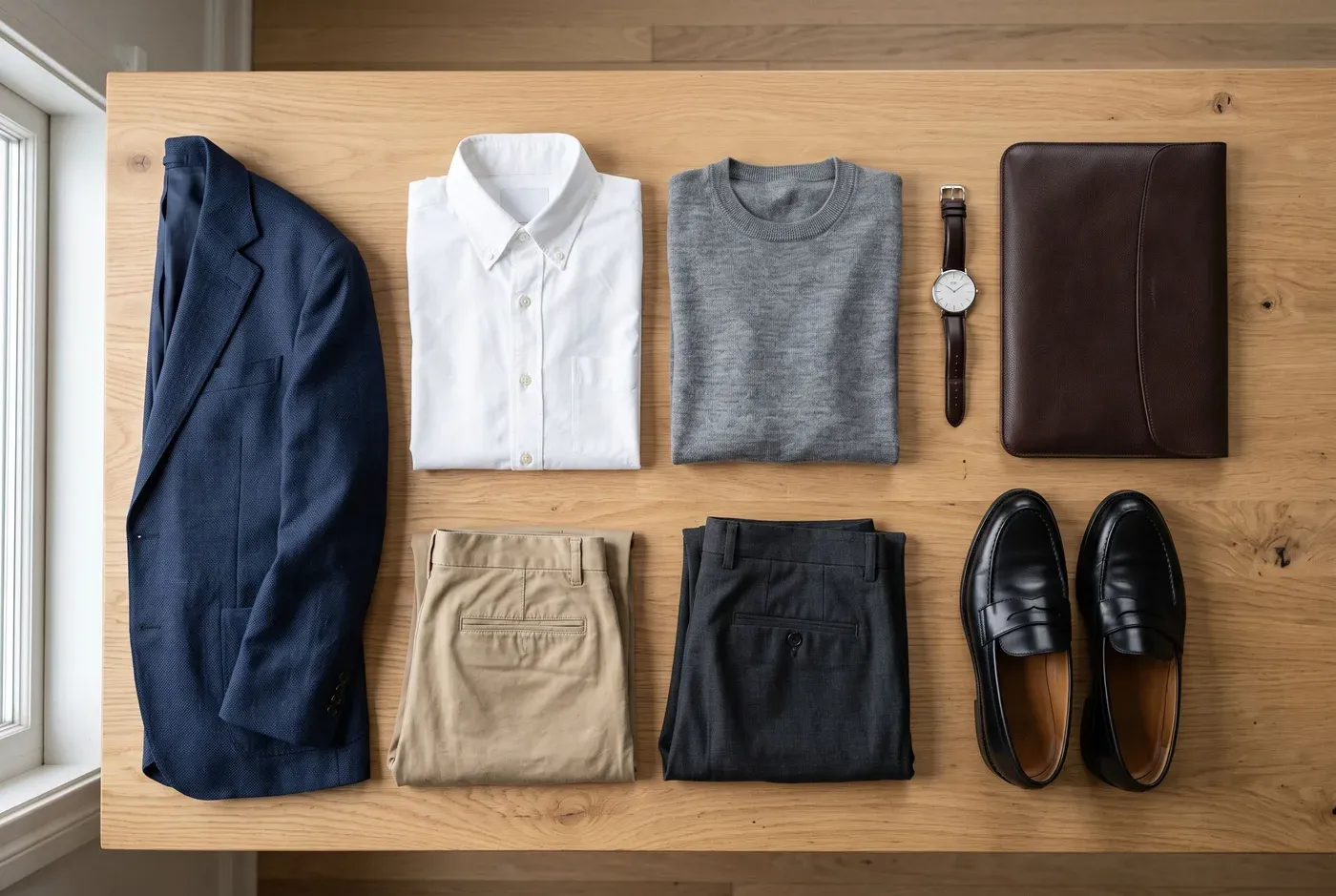
Neutral bases such as navy, grey and khaki make everything interchangeable. Add one accent color, like burgundy or forest green, for personality. Our guide to what colors go with navy has ten combinations that work at the office.
Business casual outfits for women
- A fine-knit sweater tucked into wide-leg trousers with loafers.
- A blouse, a midi skirt and ankle boots.
- A knit dress with a longline cardigan and flats.
- A crisp shirt, straight trousers and a blazer for big meetings.

Comfort counts at work. Choose fabrics with a little stretch or drape, shoes you can walk in and layers you can remove when the office heating kicks in.
Business casual outfits for men
- An oxford shirt with a crewneck sweater and khaki chinos.
- A quarter-zip knit over a collared shirt with olive chinos.
- A polo, tailored trousers and loafers for warmer days.
- A blazer, shirt and dark trousers when you’re presenting.

Ties are rarely needed. Keep one at your desk for surprise meetings, along with a blazer, and you’ll be ready for anything.
A week of business casual outfits
Here’s a Monday to Friday plan built from about ten pieces:
- Monday, team meeting: navy blazer, white shirt, grey trousers and loafers.
- Tuesday, desk day: grey fine-knit sweater, khaki chinos and flats or derbies.
- Wednesday, client call: burgundy knit, dark tailored trousers and loafers.
- Thursday, busy day: oxford shirt, olive chinos and low boots.
- Friday, relaxed day: knit polo or blouse, dark jeans without rips and clean leather shoes.
Notice how the loafers, grey trousers and navy blazer appear more than once. Repeating strong basics is what makes a work wardrobe easy. Our guide to planning outfits with AI shows how to turn this into your own weekly routine.
Business casual mistakes to avoid
- Ripped or heavily distressed jeans.
- Clothing with slogans or large graphics.
- Hoodies and athletic zip-ups as your top layer.
- Open-toed or athletic shoes. Most guides recommend closed-toe shoes in the office.
- Wrinkled shirts. Fit and care matter more than price.
- Ignoring your office. When in doubt, match the most polished person on your team.
Stylist tip
Keep a blazer at the office. It turns any business casual outfit into a meeting-ready look in seconds. Our guide on how to style a blazer has ten more ideas.
How to plan business casual outfits with Outfitual
Add your workwear to your Outfitual wardrobe with categories, colors and notes like “client-ready” or “too warm for summer.” Then ask your AI stylist, “Plan five business casual outfits for next week,” and drop your favorites into the outfit planner. Log what you actually wear, and cost per wear will show which work pieces are paying their way. Heading somewhere after work? Our smart casual guide explains how to adjust your look.
Поширені запитання
Are jeans business casual?
In many offices, dark, clean jeans without rips count as business casual, especially with a blazer or collared shirt. Some industries still expect trousers or chinos, so check your company’s dress code or follow what colleagues wear.
Can I wear sneakers for business casual?
Most business casual guides recommend closed-toe leather shoes such as loafers, derbies or flats. In relaxed offices, clean minimal leather sneakers may be fine, but avoid athletic and running styles.
Do you need a blazer for business casual?
No. A blazer is optional in business casual. It’s useful for meetings and presentations, but a sweater, cardigan or collared shirt is enough on most days.
What colors are best for business casual?
Neutrals such as navy, grey, khaki, white, black and camel work best as a base. Add one or two accent colors, like burgundy or forest green, to keep your work outfits interesting.
YOUR PERSONAL AI STYLIST
Your wardrobe, reimagined.
Outfitual brings your clothes, an AI stylist, virtual try-on and an outfit planner into one app. Start free today.



About the author
Rico Glosio is Outfitual’s style editor, writing about personal style, color and the trends worth actually wearing, always starting with what’s already in your wardrobe. Rico’s own closet runs on black tailoring and crisp white shirts, with color added one experiment at a time. More style guides.